
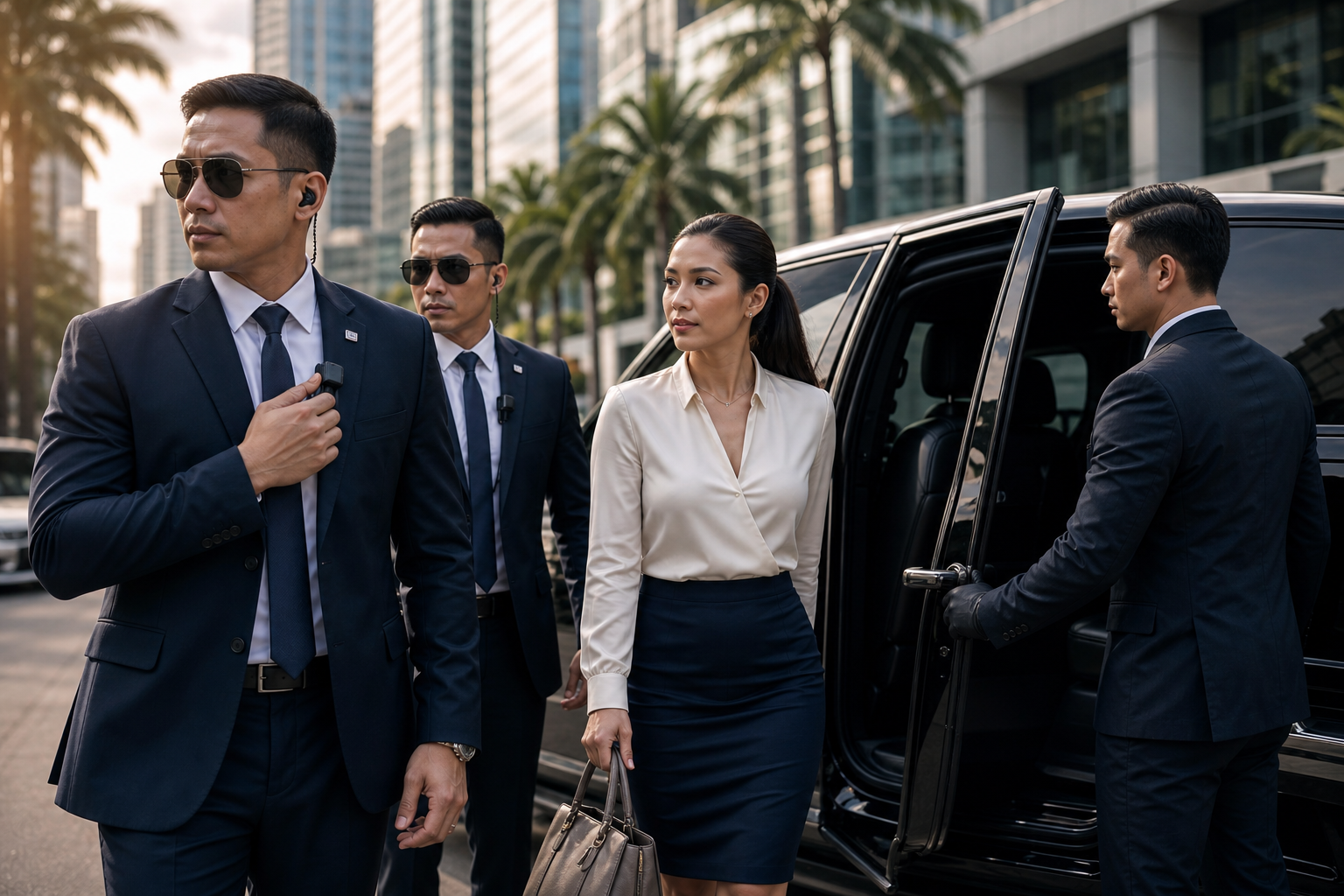
High-net-worth travelers, executives, and public figures often assume that hiring a bodyguard is straightforward. The reality in the Philippines is more complex, and a mismatched protection team can create more problems than it solves. Secure travel, discreet residential protection, and event safety require staff who understand local risks, legal limits, and cultural nuance. This guide explains how to find and hire truly elite VIP security Philippines providers, what standards to demand, and how to craft a protection plan that actually works.
Why VIP security in the Philippines needs a local, specialized approach
The Philippines combines dense urban centers, busy coastlines, and politically active regions, all of which produce security challenges that differ from country to country. Metro Manila brings traffic, high-rise living, and a steady calendar of public events where crowds and protests may converge. Key ports and tourism zones see a mixture of petty crime and organized theft rings. Parts of the south continue to experience insurgent activity, and natural disasters add a layer of complexity to emergency planning.
An effective VIP security team understands these local realities. They know how to secure routes through congested traffic, coordinate with local authorities, and respond to typhoon, earthquake, or flood scenarios while maintaining continuity of protection. Local specialists also grasp cultural signals that international teams can miss, such as the proper handling of media, private neighborhood expectations, and how to read crowd behavior in different Filipino communities. That contextual knowledge is the baseline for any truly elite protection service in the Philippines.
What professional VIP protection looks like
VIP security in the Philippines covers a spectrum of services that must be tailored to the principal, the threat profile, and the operational environment. At the core are a few distinct types of protection.
Close protection and executive protection involves trained operatives who stay near the principal to observe threats, manage access, and move the principal safely during daily routines. These agents combine situational awareness with de-escalation, protective driving, and emergency medical response skills.
Advance work and route planning happens before travel or public appearances. Advance teams inspect venues, map out alternative routes, check ingress and egress points, and set contingency sites. Good advance work often prevents incidents altogether.
Residential protection secures the home environment without turning it into a fortress. This includes layered access control, integration with local watchmen, visitor management, surveillance systems, and a plan for evacuation or lockdown when needed.
Event security scales protective measures for speeches, performances, or fundraisers. It involves crowd management, credential control, coordination with venue security and local police, and procedures to isolate threats quickly.
Travel and maritime security covers everything from airport transfers and embassies to yachts and inter-island movement. This area demands logistics experience, knowledge of ports, visas, and sometimes coordination across jurisdictions.
Cyber and communications security is a critical addition. Secure communication channels, phone hygiene, social media guidance, and protection against digital tracking are essential components of modern VIP protection.
Legal, licensing, and regulatory checks to require
Before engaging a provider, verify they operate within Philippine regulatory frameworks. Professional security firms should be registered entities with corporate documentation in order, and they should hold the required licenses issued by the appropriate oversight office of the Philippine National Police. Ask for copies of those licenses and confirm their validity.
Personnel carrying firearms must show individual firearm permits. Confirm that those permits are current and that firearms are registered. Security staff also need clear background checks; request National Bureau of Investigation or police clearances for core team members.
Insurance is another non-negotiable item. The security provider should carry liability insurance that covers injury, property damage, and third-party claims. If the operation requires armed response, verify how force policies are documented and how liability will be handled.
Qualifications and training you should expect from elite protection teams
An elite team focuses on continuous, relevant training rather than checkbox credentials. Expect to see formal instruction in close protection techniques, defensive driving, tactical first aid or tactical casualty care, firearms proficiency when applicable, and de-escalation and crowd management. Look for certifications from reputable training organizations and ask for details of recent refresher training.
Experience matters. Team members with prior military, police, or long-standing private protection backgrounds bring operational discipline. For roles that involve driving, ask for evidence of specialized armored or evasive driving instruction. For medical responsibilities, demand current CPR and trauma care certifications.
Language skills and cultural competence are often overlooked but critical. Agents should be fluent in English and at least conversational in Filipino or the dominant regional language where the principal spends time. That fluency allows discrete communication and smoother local interaction.
Vetting, screening, and documentation to get from a provider
A rigorous vetting process protects both the principal and the hiring organization. Request the following items and verify them independently.
- Full identity documentation and government-issued IDs for each team member, plus recent photograph comparisons.
- Criminal record checks or police clearances.
- Employment history and verifiable references from previous principals or employers.
- Copies of relevant licenses and certifications.
- Medical fitness, drug testing, and vaccination records where required by travel plans.
- Copies of firearm permits for armed personnel.
- Proof of insurance coverage that specifically mentions security operations.
Ask for a written confidentiality agreement and non-disclosure arrangements. Sensitive client information must remain restricted to a minimal set of cleared personnel.
Equipment, communications, and logistical capabilities
Equipment decisions should reflect risk, visibility preferences, and the principal's tolerance for overt vs covert protection. For visible deterrence, armored vehicles, uniformed static guards, and CCTV are appropriate. For discreet protection, plain-clothes close protection agents, unmarked vehicles, and low-profile surveillance work better.
Communications must be redundant and secure. A professional team uses encrypted radios or secure telephony for mission-critical exchanges, and they maintain contingency communications such as satellite phones for remote areas or during natural disasters. Confirm that teams can integrate with the principal's devices while implementing secure comms practices and protecting sensitive data.
Advance teams should maintain local contacts that include transport operators, reliable mechanics, medical facilities, and law enforcement liaisons. For travel across islands or international legs, verify that the provider can handle visas, diplomacy requirements, and cross-border logistics.
How to structure the hiring process and contract
Start by defining the scope of protection in clear, written terms. Spell out hours of coverage, geographic limits, whether firearms will be carried, expected travel, and any special events. A statement of work should list deliverables such as advance reconnaissance, daily reporting cadence, incident reporting protocols, and security assessments.
Request a proposal that includes personnel resumes, equipment lists, insurance certificates, and sample operational plans. Conduct in-person interviews with proposed team members. Observe their comportment, communication skills, and the principal-agent chemistry. Run a scenario-based exercise during selection, even if brief, to see how the team reacts under stress and whether they communicate clearly.
Contracts should cover payment terms, confidentiality, liability, termination clauses, and how disputes are resolved. Make sure the contract specifies a force policy and the legal jurisdiction governing the agreement. For expatriates or foreign principals, include provisions for interaction with embassies or consular services.
How pricing works and what determines costs
Cost depends on personnel quality, the number of agents, hours of coverage, specialized equipment such as armored vehicles, and how much advance work is required. Pricing also rises for high-risk environments, 24/7 residential protection, and international travel with complex logistics. Expect to pay a premium for highly experienced agents, comprehensive insurance, and teams that maintain redundant communications and specialized vehicles.
Rather than fixating on the lowest quote, compare proposals on what they deliver. A lower-cost provider may cut corners on vetting, training, or insurance, increasing exposure. Agree on billing milestones and additional charges for overtime, last-minute changes, or relocations.
Red flags that should stop negotiations immediately
Several warning signs indicate a provider cannot deliver elite protection. These include spotty or unverifiable licenses, refusal to provide references or background checks for core personnel, lack of insurance or ambiguous liability coverage, and aggressive sales tactics that promise unrealistic guarantees. Also be wary if a vendor lacks documented emergency procedures or cannot provide recent training records. Finally, avoid teams that cannot demonstrate local relationships with medical facilities or have no plan for coordination with local authorities when required.
Examples of protection plans tailored to common VIP scenarios
Traveling executive arriving for a series of meetings in Manila: An effective plan starts with advance route reconnaissance to avoid traffic hotspots during peak hours, an unmarked driver trained in defensive driving, two close protection agents in plain clothes for daily movements, secure hotel liaison staff, and a plan for rapid extraction to the airport if needed. Secure communications, a vetted local clinic contact, and daily risk briefings complete the package.
Celebrity attending a public charity event: Event protection emphasizes crowd management and media coordination. The team conducts venue sweeps, establishes controlled access points, assigns visible perimeter guards to deter opportunistic incidents, and positions close protectors near the principal. Media handling protocols and social media guidance prevent inadvertently revealing location details.
Long-term resident with family in a gated community: Residential protection focuses on layered security inside and outside the home. That means integrating perimeter sensors, secure entry protocols, trusted local watchmen, plain-clothes internal staff for daily protection, and a clear evacuation route and emergency survival kit for natural disasters. The team also manages household staff vetting and visitor screening.
Final checklist to use when evaluating a candidate provider
Before you sign, confirm these items are in place and verifiable: valid corporate and operational licenses, individual permits for armed agents if applicable, proof of insurance, recent and relevant training certificates, objective references from similar assignments, transparent pricing and contract terms, and evidence of local logistical and medical contacts. If any of these boxes remain unchecked, push for resolution before committing.
A few practical tips to get the best protection
- Invest in advance work. The cost of a short advance visit is small compared with the cost of reacting on the fly to an unexpected threat.
- Keep a center of decision-makers small. Too many people with access to sensitive plans increases risk.
- Rotate team composition thoughtfully. Continuity builds trust and understanding, but occasional rotation prevents insider complacency.
- Prioritize secure communications. In many incidents, lapses in communication make an otherwise manageable event escalate.
- Plan for non-security contingencies. Evacuation during a typhoon, medical emergencies, or transport breakdowns should be built into the protection plan.
Choosing the right VIP security Philippines provider prevents disruption, protects reputation, and preserves freedom of movement. Vet teams thoroughly, insist on verifiable training and licensing, and demand clear contracts and insurance. A well-chosen team blends discreet service with robust operational skills, allowing principals to work, travel, and live with confidence.
Hire wisely, require transparency, and keep operational plans current. With the right provider, protection becomes an enabler rather than an intrusion.