
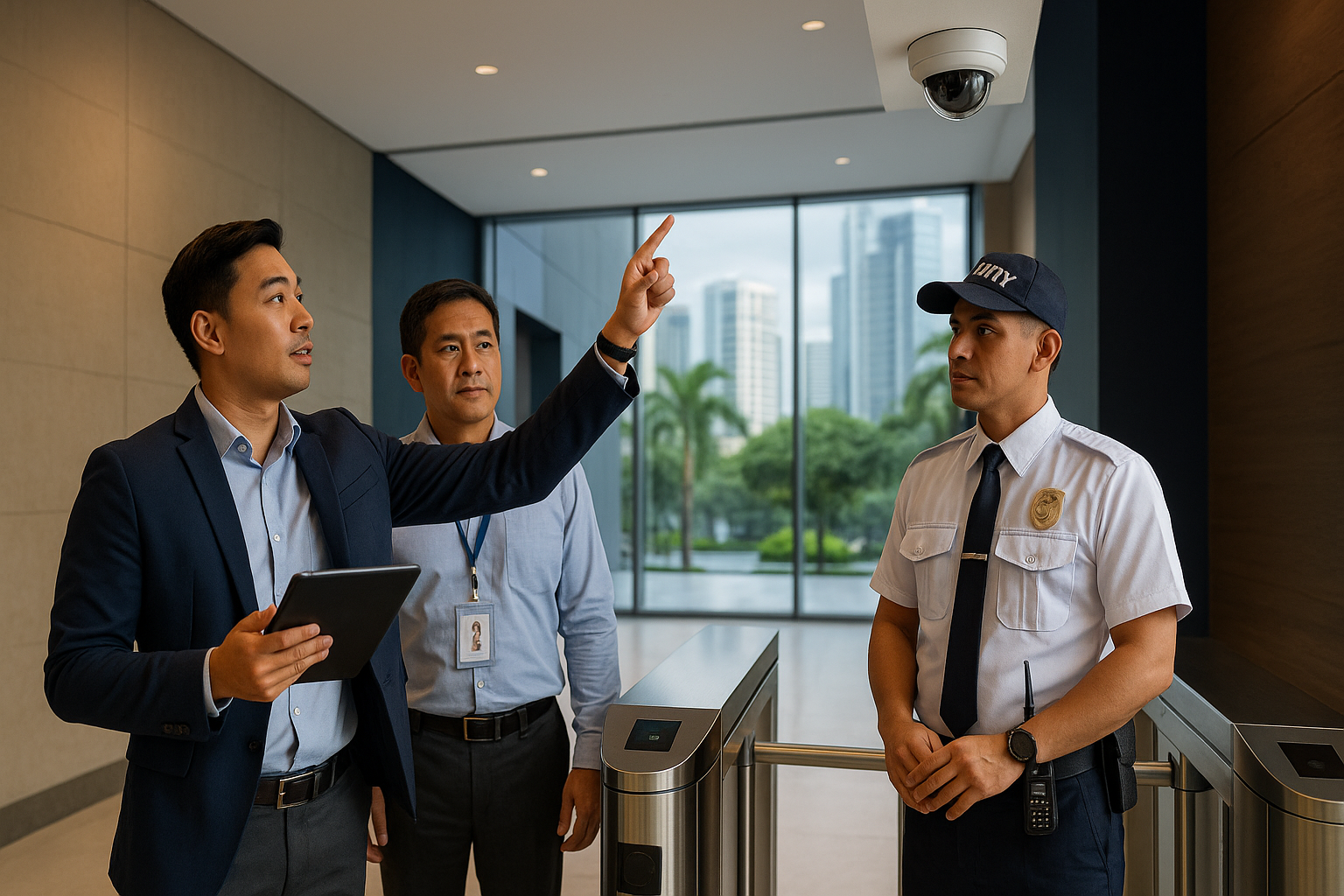
Hook A single weekend without power, a damaged server room after a typhoon, or a single unlit entry point can be the beginning of a chain reaction that costs a business far more than the immediate loss. Many Philippine companies treat security as an afterthought, until an incident forces an urgent, expensive response. A well-executed security survey changes that reactive posture into a planned, measurable approach to reducing risk.
Introduction
A Security survey Philippines is a systematic review of a site, its systems, people, and processes, done to identify vulnerabilities, assess threats, and produce a prioritized plan for mitigation. For businesses operating in the Philippines, the right survey accounts for not only criminal threats, but also environmental hazards, infrastructure limitations, and legal requirements that affect operations and employee safety. This guide explains what a business should expect from a security survey, how to commission one, and how to turn findings into practical improvements you can afford and implement.
What a security survey delivers A competent security survey produces more than a list of problems. It delivers a clear description of vulnerabilities, the likelihood and impact of potential incidents, and a prioritized roadmap of technical fixes, operational changes, and training that reduces overall risk. Typical deliverables include a site map annotated with vulnerabilities, a narrative risk assessment, photographs of problem areas, costed recommendations, and an implementation timeline. The final report should be usable as a basis for budget approvals, tendering for equipment or contractors, and conversations with insurers or local authorities.
Why businesses in the Philippines should prioritize a security survey The Philippines presents a mix of everyday criminal risks and recurring environmental threats that shape the security profile of businesses. Urban areas can experience opportunistic theft, motorcycle snatch theft, and vandalism, while facilities outside metropolitan centers may face issues with longer emergency response times. Seasonal typhoons, flooding, and occasional power instability create additional risks for both physical assets and IT systems. Finally, laws and regulations, such as workplace safety rules, the Data Privacy Act, and fire regulations, mean that security decisions have legal and compliance consequences as well as financial ones. A security survey calibrated to this environment helps businesses focus limited resources where they matter most.
Core elements a Security survey Philippines should cover A thorough security survey covers six interconnected domains: perimeter and access control, surveillance and detection, building and infrastructure, cyber and data protection, people and procedures, and emergency preparedness. Each domain should be assessed both for current state and for the practical measures that will substantially reduce risk.
Perimeter and access control Start at the edge. The survey should evaluate fences, gates, vehicle entry points, pedestrian access, visitor controls, and contractor procedures. Common weaknesses include unsecured loading bays, gates left open after hours, and poorly managed keys or access cards. For retail sites, the parking area and customer entrances are critical. For warehouses, the receiving area often represents the highest risk because it involves third-party drivers and frequent loading activity. Recommendations might include better gating, a secure visitor log, lockable bollards, and improved screening of service contractors.
Surveillance and detection CCTV placement is less useful when cameras are aimed at empty stretches or suffer from poor lighting. The survey must review camera coverage, camera quality, storage retention, and who has access to footage. It should also assess intrusion detection systems, alarms, and perimeter sensors. For many businesses a modest refresher of camera angles and lighting adjustments eliminates blind spots at low cost. For high-value sites, integration between CCTV, access control logs, and alarms gives faster, more reliable incident response.
Building and infrastructure Inspect structural vulnerabilities and secondary hazards. That means server rooms, mechanical rooms, electrical panels, emergency exits, roof access points, and storage of hazardous materials. Many incidents trace back to simple failures: water entering a server room during heavy rains, cabinets left unlocked, or emergency exits obstructed by inventory. The survey should flag issues that increase vulnerability to environmental events, such as poor drainage that allows flooding, or electrical circuits that are overloaded because of ad hoc extensions.
Cyber and data protection Physical security and cybersecurity now overlap. The survey should inventory network equipment, how devices are physically protected, backup power for critical systems, and redundancy for internet and power. It must consider where sensitive data is stored and who can access it. CCTV systems and access control often connect to the network and represent attack surfaces. The report should recommend simple but effective controls, such as network segmentation, regular patching, enforced passwords, secure off-site backups, and a plan to restore operations after a ransomware or system failure.
People and procedures People cause or prevent most incidents. The survey must assess staffing levels for security, training, contractor management, and staff policies. Are guards trained to handle common incidents? Are visitors screened and escorted? Are maintenance requests tracked so temporary repairs do not become permanent vulnerabilities? Procedures that work on paper can fail in practice. The survey should include interviews with front-line staff to identify gaps between written procedures and what happens day to day.
Emergency preparedness and business continuity Business resilience is not a single item. It combines backup power, data recovery, evacuation procedures, and relationships with local emergency services. The survey should test evacuation routes, verify the availability of first aid and firefighting equipment, and review vendor contracts for rapid replacement or repair of critical assets. In the Philippines, plans for typhoon response, water ingress, and labor continuity when transportation is disrupted are essential.
How to commission a security survey: a practical process Define objectives and scope. Decide whether the survey will cover a single site, multiple facilities, a specific function such as warehousing, or both physical and cyber components. Clarify what success will look like. Is the goal to reduce theft by 50 percent, to pass a regulatory inspection, or to improve staff safety?
Prepare basic documents. Collect site plans, access logs if available, incident history, and insurance requirements. These materials let the consultant focus on observation and interviews during on-site work rather than administrative discovery.
Choose the right consultant. Look for consultants with local experience and a balance of practical security know-how and technical competence. Ask for sample reports and references from Philippine businesses in similar sectors. Credentials matter less than proven local performance. Confirm they will perform an on-site visit, interview staff, and deliver a clear, costed action plan.
Site visit and interviews. A thorough survey involves walking the premises at different times, including before dark if night operations exist. It includes speaking with security guards, facilities staff, managers, and a sample of employees who use the space daily. Photographs and schematic diagrams produced during the visit are essential for later prioritization.
Analysis and report. Expect a report that explains each vulnerability, estimates likelihood and consequence, and provides prioritized recommendations with indicative costs and implementation timeframes. The best reports also give short-term remedial actions that can be implemented immediately while longer-term projects are planned.
Implementation and monitoring. A survey is only valuable if the recommendations are implemented. Prioritize items that eliminate high-probability, high-impact risks first. Track progress against the recommended timeline and reassess after implementation to confirm effectiveness.
Choosing a consultant: what to ask for and expect Ask a prospective consultant for past work in the Philippines, client references, sample deliverables, and clarity on fees and scope. Expect a clear methodology that explains how they score risk and select priorities. Confirm whether they will help with tender documents or contractor selection if you need new equipment or installation services. Avoid firms that offer a one-size-fits-all checklist and prefer those that tailor recommendations to site specifics and local operating conditions.
Common findings and how to prioritize fixes Surveys in the Philippines often highlight the same recurring issues, which gives you a practical roadmap for prioritization. Low-cost, high-impact fixes include improved lighting, securing external doors, and simple CCTV angle adjustments. Mid-level investments might include access control upgrades, modest perimeter reinforcements, or backup power for the server room. Long-term projects include restructuring traffic flow for safer deliveries, major CCTV system upgrades with centralized monitoring, and full business continuity planning with off-site replication of critical systems.
When deciding what to do first, prioritize items that reduce both the likelihood and the consequence of incidents. For example, a server room flood could stop operations for days, so waterproofing and elevating equipment should rank high. Replacing a single vandalized camera might be lower priority if the broader surveillance plan leaves only a small blind spot.
Practical examples for three common business types Retail store: A mid-sized mall shop may suffer from shoplifting and employee theft. A security survey would inspect store layout, mirror and camera placement, POS access controls, and stockroom security. Practical remedies might include moving high-value items, adding a low-cost camera covering the store exit, instituting tighter cash-handling procedures, and training staff on identifying suspicious behavior.
Warehouse and distribution center: The biggest vulnerabilities are often at receiving docks and perimeter fencing. The survey would test gate procedures, contractor vetting, lighting of yards, and inventory control systems. Recommendations could include locking off unused dock doors, improving gate logs, installing better lighting and motion sensors, and adding security checks to reconcile deliveries.
Corporate office: Offices face a mix of physical access issues and data security risks. The survey would examine reception processes, badge controls, server room protection, and remote access policies. Expected fixes include stronger visitor sign-in procedures, better segregation of server equipment, enforcing multi-factor authentication for remote access, and an updated incident response plan for data breaches or ransomware attacks.
Working with local authorities and regulators Engage with local barangay officials, police stations, and fire authorities early, especially for facilities outside major urban centers where formal emergency response may take time to arrive. For surveillance systems, consult guidance from the National Privacy Commission about the lawful collection and retention of personal data through CCTV. For workplace safety, verify requirements with the Department of Labor and Employment and coordinate with the Bureau of Fire Protection on fire drills and compliance with fire safety codes. These relationships also help when you need rapid police response or community notice about events affecting operations.
Measuring success and the return on security investment Value from a security survey comes from reduced incident frequency, lower loss amounts, improved uptime, and sometimes lower insurance premiums. Track metrics such as incident reports, theft losses, mean time to recover from outages, and staff safety incident rates. Qualitative benefits include better staff confidence and clearer responsibilities. Reassess annually or after major changes to operations, and repeat a full survey every two to three years or whenever a new threat or technology arises.
Final thoughts A Security survey Philippines is not an academic exercise. It is a practical tool to reveal where a business is exposed, and how limited resources can produce the largest reduction in risk. By focusing on local hazards, realistic fixes, and clear implementation plans, a well-run survey converts anxiety about exposure into concrete improvements that protect people, property, and business continuity. Take the time to choose a consultant who understands local realities, follow through on prioritized actions, and measure outcomes so every peso spent on security strengthens your resilience.