
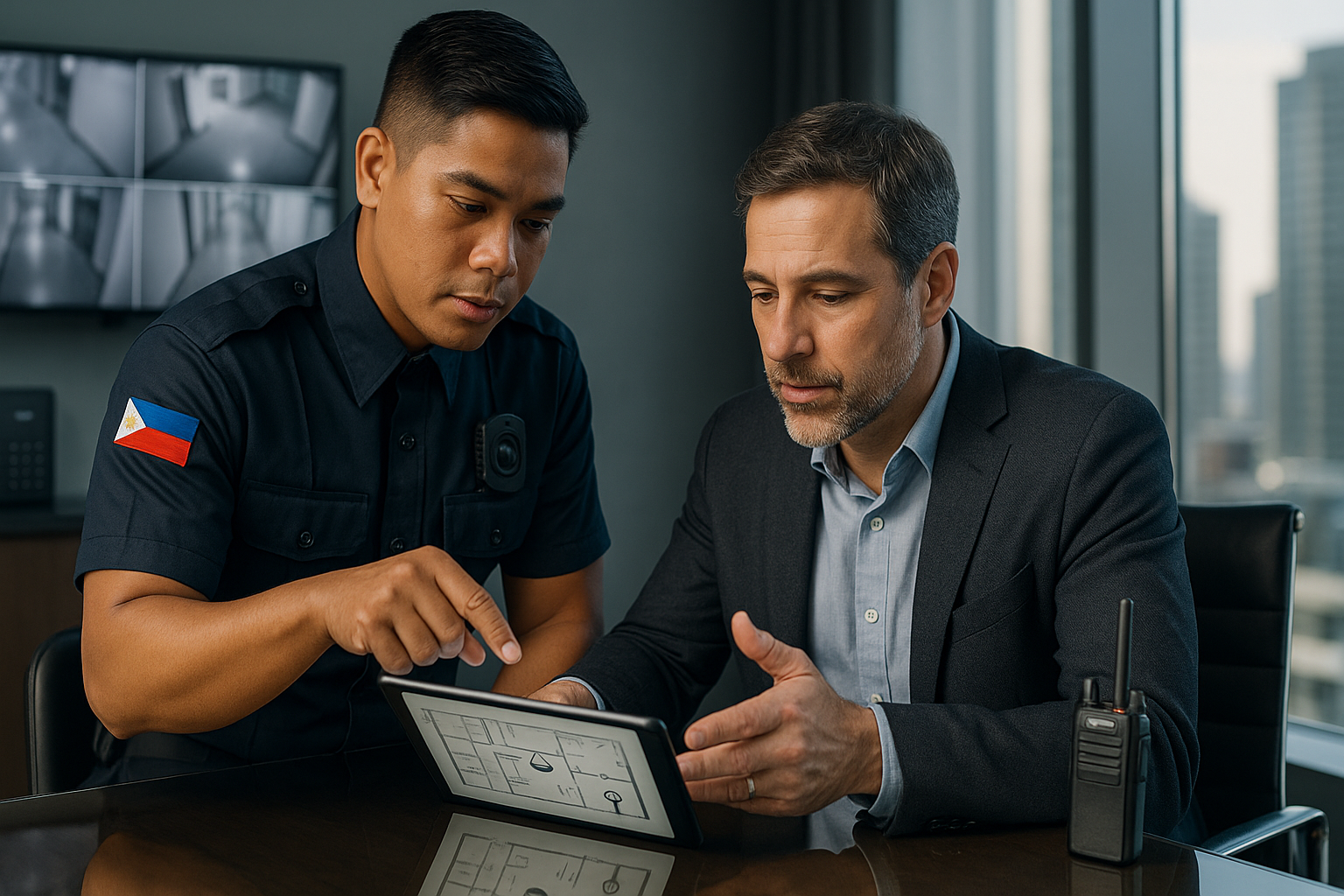
A security guard on the wrong shift, cameras that never record, or a contract full of vague obligations can turn a routine vendor decision into a costly liability. Choosing the right security partner Philippines affects safety, compliance, and the bottom line, yet many organizations treat it like a commodity.
Introduction
Selecting a security partner Philippines requires more than comparing hourly rates. You are buying a combination of people, processes, and technology that must operate reliably under pressure. Whether you manage a condo association, run a factory, operate a retail chain, or plan public events, the provider you pick will shape how quickly you detect risks, how incidents are handled, and how stakeholders — from employees to regulators — perceive your organization. This article walks through the practical steps to evaluate providers, the core capabilities to demand, questions to ask, examples tied to common use cases, and the contract elements that protect your interests.
Why the right security partner matters Security services are visible at the front line, but their impact runs deeper. A competent partner reduces theft, fraud, and workplace violence. They help maintain regulatory compliance and can lower insurance premiums. They also preserve reputation. A single badly handled incident can cost more than a year of contract savings. On the other hand, an overly rigid or poorly trained provider creates friction with staff and residents, and obscures real security gaps with a false sense of control. The goal is not cost minimization, it is risk alignment: pick a partner whose capabilities, culture, and operating model match the specific threats and expectations you face.
What a good security partner Philippines should offer Services that match risk, not one-size-fits-all coverage. Core offerings usually include manned guarding, mobile patrols, access control, CCTV monitoring, emergency response coordination, incident reporting, and investigative support. For higher-risk sites, providers should offer armed guard teams, K9 units, technical surveillance countermeasures, and close-protection for executives. A capable partner will propose a tailored mix of these services rather than selling a standard package.
Technology and systems that work together. Providers should integrate people with tools. Expect electronic guard tour systems, cloud-based incident reporting, remote monitoring capabilities, and secure video storage for at least 30 days. Confirm how systems connect to your operations, who owns the data, and how access is controlled.
Training, supervision, and human factors. Guards are the public face of your security program. Look for structured training that covers legal powers and limitations, de-escalation, emergency procedures, customer service, and site-specific hazards. Rotational supervision, regular site inspections, and refresher training are essential to keep performance consistent.
Regulatory compliance and insurance. A reputable partner will be able to document required licenses, permits, and insurance coverage. They should also be familiar with relevant labor regulations, wage requirements, and occupational safety rules, and they must provide proof that staff receive statutory benefits.
Local footprint and scalability. Your provider should have a local presence near your site so they can respond fast and understand local conditions. At the same time, they should be able to scale up for seasonal demands, new sites, or special events without long lead times.
Evaluating credentials and trust signals Licensing and legal standing. Confirm the agency's operating license and ask to see identification for supervisors and guards. Insist on written proof of registration with relevant government agencies. If the agency cannot produce verifiable documentation quickly, treat that as a serious warning sign.
Insurance and bonded employees. Providers should carry liability insurance that covers bodily injury, property damage, and errors and omissions. Bonding for employees reduces the risk of theft by staff. Ask for policy certificates and contact information for the insurer if you need to verify coverage.
Client list and references. A solid provider will share recent references and case studies that align with your industry or site size. Contact references and ask about responsiveness, incident handling, and whether the provider stuck to contract terms.
Background checks and vetting practices. Find out how the provider screens recruits. Standard practices include criminal history checks, verified employment history, drug testing, and periodic re-screening. Compliance with these practices reduces insider risk.
Supervisory structure and escalation paths. Ask how supervisors are assigned, how many guards each supervisor oversees, and how escalation works during an incident. A single point of contact should manage your account with a clear backup when that person is unavailable.
Questions to ask potential providers What is your response time and how is it measured? Response time matters more than theoretical coverage. Request a committed response time for priority incidents and ask how it is tracked.
How do you handle recruitment, training, and retention? Turnover undermines security. Learn about pay scales, incentives, career development, and any programs the provider uses to keep guard teams motivated and stable.
Who owns incident data and how is it shared? Clarify data ownership, retention periods, and secure access protocols. You should receive timely, searchable incident reports that can be used for audit and insurance purposes.
Can you provide a sample service level agreement? The SLA should specify guard numbers, patrol frequencies, reporting cadence, KPIs, penalties, and a process for contract amendments.
How do you integrate with internal teams and local authorities? Your partner must coordinate with your HR, facilities, and local emergency services. Ask for examples where the provider worked with police or fire departments on an incident.
What is your continuity and contingency planning? Confirm redundancy for key roles, back-up power for monitoring centers, and plans for mass absences or a major incident.
Matching providers to typical scenarios Retail and shopping centers. High foot traffic creates loss and safety challenges. Look for a partner that blends visible uniformed patrols with plainclothes loss-prevention officers, CCTV analytics to spot unusual patterns, and incident reporting that feeds back to store managers. Fast, respectful engagement with customers is essential to avoid escalation.
Residential buildings and condominium associations. Residents value both safety and neighborly service. Providers should emphasize community policing, visitor management, concierge-style access control, and conflict de-escalation. For larger developments, insist on perimeter monitoring and an integrated CCTV system that the condo association can access as needed.
Offices and corporate campuses. Employers want asset protection and employee safety. Providers should coordinate with security or HR teams, handle access credentials, and provide emergency evacuation support. For campuses open to the public, balance customer experience with stricter access zones.
Manufacturing and industrial sites. These sites need guards trained to handle hazardous materials, protect large equipment, and secure remote perimeters. Look for providers experienced in industrial environments, capable of operating within confined space safety rules, and able to manage contractor access.
Events and temporary security. Event security requires rapid scaling and flexible staffing. Ensure the provider can do crowd control planning, stage perimeter protection, credential management, and rapid medical triage coordination if needed.
Contracts, service levels, and measuring performance Define measurable KPIs. Useful metrics include missed patrols, average response time to priority incidents, number of reported incidents resolved within a given timeframe, training hours per guard, and turnover rates. Require monthly performance reports and quarterly reviews.
Specify incident handling and escalation. The contract should require immediate notification for serious incidents, a written incident report within a defined period, and an after-action review for any event that triggers a major response. Define who on your side must be notified and within what time frame.
Build in audits and site inspections. Include rights to audit the provider's payroll and training records on a periodic basis. Unannounced site inspections reveal the real state of readiness better than scheduled visits.
Protect data and privacy. Include clauses that limit video and personal data use, specify retention timelines, and require secure disposal procedures. Insist that the provider comply with relevant data privacy laws.
Address labor compliance and wage transparency. Contracts should require the provider to comply with statutory labor obligations, provide proof of wage payments and contributions, and absorb any penalties arising from their noncompliance. This protects you from secondary liability.
Plan transitions and exit terms. Migration plans should cover handover of keys, credentials, equipment, and incident histories. Define notice periods and a transition assistance clause so you are not left exposed when a contract ends.
Cost considerations and avoiding false economy Lowest price often hides the real cost. Cheaper providers may underpay guards, leading to high turnover and poor morale. They may delay equipment maintenance or skimp on training. Evaluate total cost of ownership, including onboarding, technology integration, and the likely cost of incidents that result from weak coverage.
Require transparent pricing. Contracts should list unit costs for guards, patrols, monitoring, overtime, equipment, and emergency call-outs. Compare proposals on equivalent service levels, not only on bottom-line price.
Consider performance-based pricing for long-term contracts. Linking a portion of fees to KPIs aligns incentives, but keep the measures clear and achievable.
Red flags to watch for Vague answers about licensing and insurance. If a provider cannot or will not show proof, walk away.
High turnover and evasive hiring practices. If interviews reveal large numbers of replaced guards in a short period, expect continuity problems.
Over-reliance on subcontractors without transparency. Subcontracting is allowable, but you must know who bears responsibility and how subcontracted teams are vetted.
Poor reporting and no audit access. If incident reports are inconsistent or the provider resists audits, you lose evidence needed for insurance claims and performance evaluations.
Claims of unrealistic response times. Promises of immediate response without local presence are often inflated. Verify by checking references and testing the provider during the proposal stage.
Final decision checklist Before you sign, confirm these items in writing: verified licenses and insurance certificates, a clear SLA with KPIs and penalties, proof of training programs, a continuity and escalation plan, transparent pricing with wage compliance assurances, data ownership and privacy clauses, and references from similar clients. Negotiate a trial period or phased rollout for larger deployments to validate assumptions under real conditions.
Short, clear conclusion Choosing a security partner Philippines means matching capability to risk, demanding verifiable credentials, and building measurable performance into the contract. A thoughtful selection process prevents expensive surprises and creates a security posture that supports operations and protects people. Take the time to verify, test, and document, and you will have a partner that strengthens safety and trust across your organization.