
Hook
A break-in happens at 2:00 a.m., your alarm sounds, but nobody answers your call and the security company you trusted takes too long to respond. That gap between an alert and an effective response is where losses and regret occur, and it is exactly what good security monitoring is meant to eliminate.
Introduction
Security monitoring Philippines covers a broad set of services, from simple home alarm monitoring to enterprise-grade video analytics, remote guarding, and armed response. Choosing the right provider means balancing cost, response capability, and compliance with local regulations. This article explains what security monitoring actually entails in the Philippine context, outlines the types of services available, profiles the kinds of providers you will encounter, offers realistic price ranges, and gives practical guidance for choosing and negotiating with a vendor.
What security monitoring means, and why it matters in the Philippines
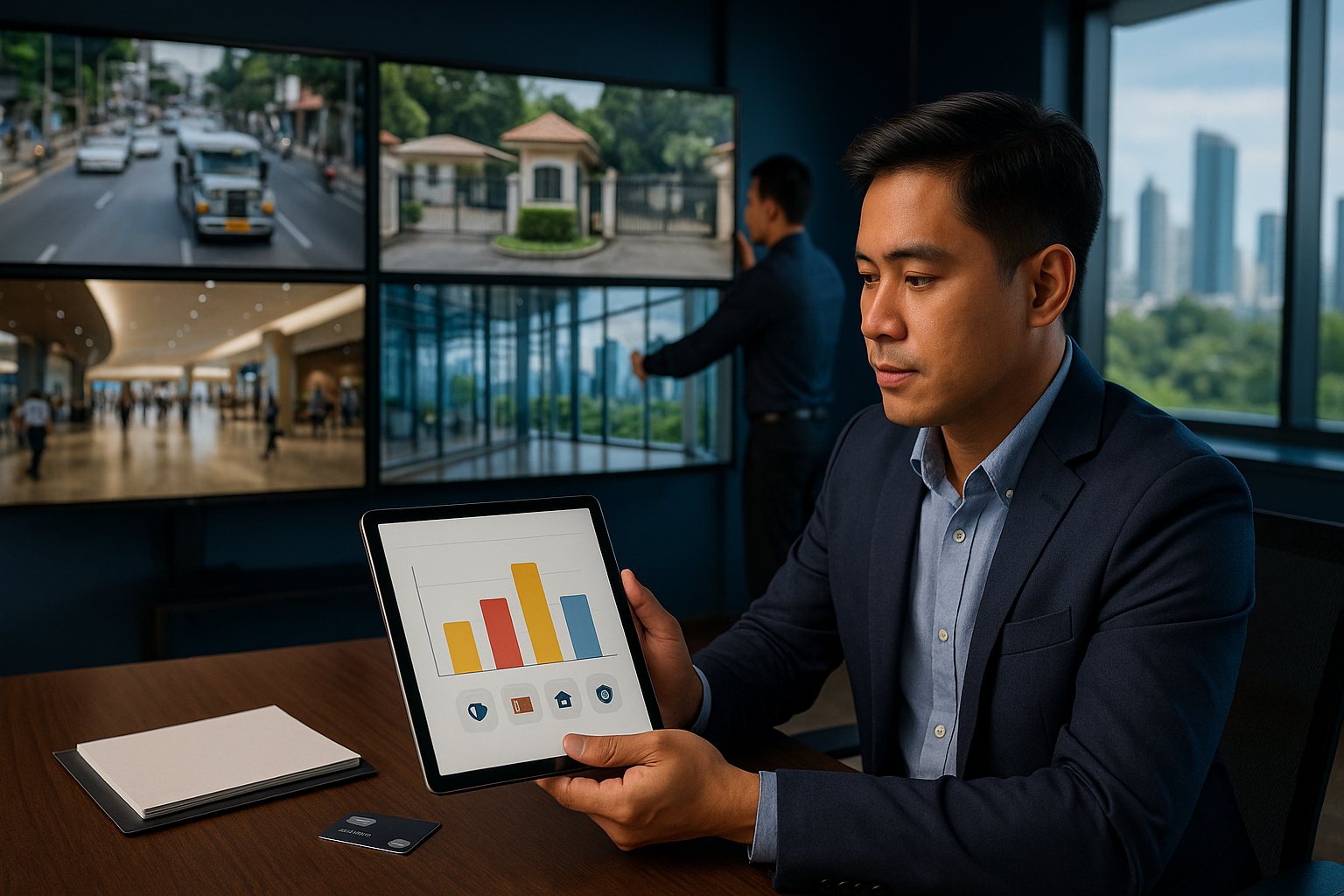
At its core, security monitoring is continuous observation, alerting, and coordination to detect and respond to threats. That might mean a 24/7 operations center watching camera feeds, an alarm panel that triggers a rapid response team, or a patrol schedule that covers a commercial compound. In the Philippines, geographic spread, traffic, and variable public response capacity make private monitoring especially valuable for businesses and residential communities. Monitoring reduces detection time, coordinates private response, and provides documented incident evidence that assists police and insurers.
Types of security monitoring services available
Alarm monitoring Alarm monitoring is the most basic monitored service. Sensors linked to a central monitoring station will generate alerts for intrusion, glass break, or door forced entry. The monitoring company receives the signal and follows a predefined protocol, which may include calling the premises, contacting a designated keyholder, and dispatching a private response team. Alarm monitoring is widely available for homes and small businesses, and costs are mainly influenced by the number of zones, sensor quality, and response arrangement.
CCTV, remote video monitoring, and managed video services Many providers offer live video monitoring where trained operators watch camera feeds and escalate suspicious activity in real time. Managed video services add cloud recording, analytics such as motion filtering, license plate recognition, and automated alarms for loitering or perimeter breach. Remote video monitoring is particularly useful for retail shops, construction sites, and logistics facilities where on-site personnel are limited.
Mobile patrol and alarm response teams Mobile patrol services perform scheduled or randomized checks of a property, verifying doors, gates, and premises integrity. When an alarm triggers, a rapid response team is dispatched. For many properties, a combination of alarm monitoring plus mobile patrol provides faster, more visible deterrence than either service alone.
Manned guards and outsourced security officers Full-time guards remain a core offering in the Philippines. Security companies supply trained, licensed guards to perform access control, perimeter checks, visitor screening, and incident reporting. Outsourcing guards moves payroll, training, and compliance obligations off the client.
Access control and remote lockdown Access control solutions combine badge systems, turnstiles, biometric readers, and centralized management. Many monitoring providers integrate access logs with their operations center so suspicious attempts generate alerts for security staff.
Fire and environmental monitoring Some monitoring services include smoke, heat, flood, and gas detection. When integrated with a central station, these sensors can trigger fire brigade notification, emergency lighting control, and evacuation alerts.
Vehicle tracking and fleet monitoring For logistics and transport businesses, GPS tracking with geofencing and driver behavior monitoring provides live location, route compliance, and theft alerts.
Top providers you will encounter in the Philippines
When you shop for security monitoring, you will meet both multinational brands and local agencies. International firms often provide standardized monitoring platforms and regional support, while local companies typically offer competitive pricing and stronger local knowledge.
International names commonly present or operating through local partnerships include ADT, Secom, Securitas, and G4S. These firms typically offer a suite of services, centralized control rooms, and global operating procedures you can expect to be uniform across markets. Their strength lies in technology platforms, vendor relationships, and experience with large-scale contracts.
Local Philippine firms range from longstanding security agencies that specialize in manpower, to technology-focused companies that offer CCTV-as-a-service and cloud recording. Local providers can be more flexible with contract terms and easier to customize for barangay-level security, retail clusters, and small to medium enterprises.
Because market configuration changes, always verify current operations, licensing, and customer reviews. Ask for client references and visit a provider’s operations center if you can.
Pricing guide for security monitoring Philippines
Below are typical price bands you can expect. Use these as planning figures only, because final quotes depend on site survey, equipment brand, contract length, and required response level.
Residential and small business alarm monitoring Installation for a basic alarm system with a control panel, three to five sensors, and professional installation typically runs between PHP 8,000 and PHP 30,000. Monthly monitoring fees commonly range from PHP 800 to PHP 2,500. Higher fees buy faster verified response, integration with mobile apps, and backup communications.
CCTV installation and managed video A single good-quality IP camera with professional installation often costs PHP 6,000 to PHP 15,000 per camera, depending on resolution and lens type. A common four-camera package with a network video recorder or cloud recording usually totals PHP 20,000 to PHP 80,000. For ongoing managed services, remote monitoring or cloud VMS typically costs PHP 400 to PHP 1,200 per camera per month.
Remote video monitoring with analytics Real-time operator monitoring and analytics for a small retail outlet can cost PHP 6,000 to PHP 20,000 per month, depending on hours monitored and whether the service includes verification and dispatch.
Security guard outsourcing Outsourcing a full-time guard is usually quoted as a monthly per-guard rate. Typical figures range from about PHP 12,000 to PHP 22,000 per guard per month. Costs will be higher for guards with specialized training, firearm handling, or supervisory roles. Hourly or per-shift rates may be offered for short-term or event-based needs.
Mobile patrol and alarm response Mobile patrol packages vary widely with frequency. A basic package with daily visits may cost PHP 6,000 to PHP 15,000 per month. Rapid alarm response add-ons raise the price depending on guaranteed response time and distance.
Enterprise monitoring and integrated solutions For office buildings, malls, or warehouses requiring integrated access control, high-resolution video analytics, and a dedicated operations center, expect larger upfront system costs and monthly managed service fees that can run from PHP 50,000 to several hundred thousand pesos per month for complex sites.
Sample budgets by scenario
Small condominium unit A compact monitored alarm system with basic sensors and monthly monitoring, plus cloud-based camera access, will likely fit a budget of PHP 12,000 to PHP 35,000 for installation and PHP 800 to PHP 1,500 per month.
Neighborhood retail shop A 4-camera system with cloud recording and remote monitoring, plus basic alarm monitoring, often costs PHP 30,000 to PHP 70,000 installed, with monthly services of PHP 1,200 to PHP 4,000.
Small warehouse or light industrial site Expect higher camera counts and analytics for perimeter protection. Initial costs commonly exceed PHP 100,000, with monthly monitoring and analytics in the PHP 8,000 to PHP 40,000 range.
Large commercial building Integrated security for buildings, including access control, visitor management, VMS, and a managed service contract, often begins in the low hundreds of thousands of pesos and monthly service fees scale with complexity.
How to choose the right provider
Define the threat you need to address Start with a clear threat assessment. Is theft the primary risk, or are unauthorized entries, staff safety, or fire hazards the main concern? Your objective determines whether you want live video monitoring, a guarded reception, or sensor-backed alarm systems.
Ask for site visits and pilot periods A reputable provider will perform a site survey. Request a written proposal based on the site visit and, where feasible, a short pilot or proof-of-concept to test response procedures.
Verify licensing, training, and insurance Confirm the security company and its guards are licensed by the PNP Supervisory Office for Security and Investigation Agencies, and that guards have completed required training. Ask for liability insurance and workers compensation coverage details.
Demand clear response protocols Get the provider to document response times, escalation steps, and communication channels. If the provider offers alarm response, check whether they have dedicated rapid response teams or rely on third-party contractors.
Request performance guarantees and measurement Negotiate service level agreements with measurable KPIs such as incident clearances, video uptime, camera coverage, and response time. Include penalties or rebates for missed KPIs, and set regular review intervals.
Consider data privacy and evidence management If you record or monitor video that captures third parties, ensure the provider follows the Data Privacy Act and has secure retention policies. Request chain-of-custody procedures for incident footage used for investigations.
Common contract terms and negotiating tips
Shorter initial contract If you are unsure, start with a 12-month contract rather than locking into long-term commitments. This gives you time to validate service quality.
Bundling can save money Bundling alarm monitoring with mobile patrol, or combining a multi-camera discount with cloud recording, may reduce overall cost. Ask for a breakdown so you know the value of each service.
Ask for price escalation clauses Inflation and wage increases can affect long-term contracts. Negotiate a predictable, capped escalation formula rather than an open-ended annual increase.
Watch for hidden fees Confirm installation, equipment maintenance, replacement policies, and any transfer fees if you change providers. Clarify what happens if a sensor or camera fails.
Red flags to watch for
Vague response procedures or no written protocols. Unclear licensing or refusal to show PNP registration. Operations center that you cannot verify or visit. Extremely low bids that seem to cut corners on equipment quality or manpower. No incident reporting, or poor customer support channels.
Legal and compliance reminders for the Philippines
Security agencies and guards must be licensed by the PNP. The Basic Security Officer Course is a regulatory requirement for guards. When you install cameras, be mindful of privacy rights under the Data Privacy Act. Avoid pointing cameras at private neighbor properties or capturing audio without consent. For fire monitoring and alarm systems, compliance with local fire codes ensures your monitoring can trigger appropriate emergency services.
Cost-saving measures that do not sacrifice safety
Focus protection where risk concentrates Putting a high-quality camera and good lighting at a frequent-loss entrance will reduce incidents more than many low-resolution cameras scattered without purpose.
Use analytics to reduce operator load Motion-filtering and rule-based alerts cut false positives and reduce the cost of live operator monitoring by focusing attention on genuine threats.
Combine technology with periodic manpower A modest number of well-placed cameras, plus nightly mobile patrols and a smart alarm system, can outperform a single continuous guard at lower cost.
Buy scalable systems Choose systems that allow gradual camera or sensor additions so you can spread capital expenditure and adapt to changing needs.
Wrap-up
Security monitoring Philippines means choosing the right mix of technology, trained personnel, and contractual guarantees. Costs vary widely, but a clear threat assessment, an informed site survey, and careful vendor vetting will keep your investment effective and predictable. Start by defining the outcomes you need, verify licensing and response protocols, and ask for transparent pricing and pilot arrangements. With that approach you will reduce the chance of being the person who hears the alarm, and waits.