
Hook
A single camera that records blurry footage and never gets reviewed does not protect a business, it creates a false sense of security. Too many commercial properties in the Philippines rely on patchwork systems or outdated equipment, and pay later when theft, vandalism, or fire interrupt operations. A well-designed commercial security program prevents incidents, reduces response times, and protects a company’s assets and reputation.
Introduction
Commercial security Philippines covers a wide range of technologies and services, from CCTV and access control to manned guarding and remote monitoring. Business owners and facilities managers must balance risk, budget, regulatory obligations, and operational practicality when choosing systems and providers. This article explains the core systems used here, the types of vendors available, how to evaluate them, and practical deployment guidance tailored to Philippine conditions.
Why commercial security matters in the Philippines
Metro centers and growth corridors in the Philippines concentrate people, inventory, and cash flows, making them attractive targets for crime. Add logistical complexity such as multiple entry points, late shifts, and mixed-use developments, and the risk profile grows. Effective commercial security reduces losses and improves continuity. It also addresses legal and contractual requirements. Insurance underwriters, landlords, and corporate clients often require specific systems and monitoring arrangements before they will approve coverage or tenancy. Finally, compliance with national laws, including the Data Privacy Act and fire safety regulations, affects how surveillance and alarm data must be handled.
Core systems for commercial security in the Philippines
Commercial security is less about single products and more about layered design. Each layer serves a purpose, and integration between layers matters.
Video surveillance and video management
Modern systems use IP cameras that stream over Ethernet, powered by PoE, into network video recorders or cloud video management systems. The important choices are image quality, lens type, low-light performance, and analytics. Business owners should favor true 1080p or higher cameras with good dynamic range for locations with variable lighting. Intelligent video analytics, when tuned properly, can reduce false alarms by filtering motion caused by rain, animals, or foliage. For businesses with vehicle traffic, license plate capture and searchable metadata accelerate investigations.
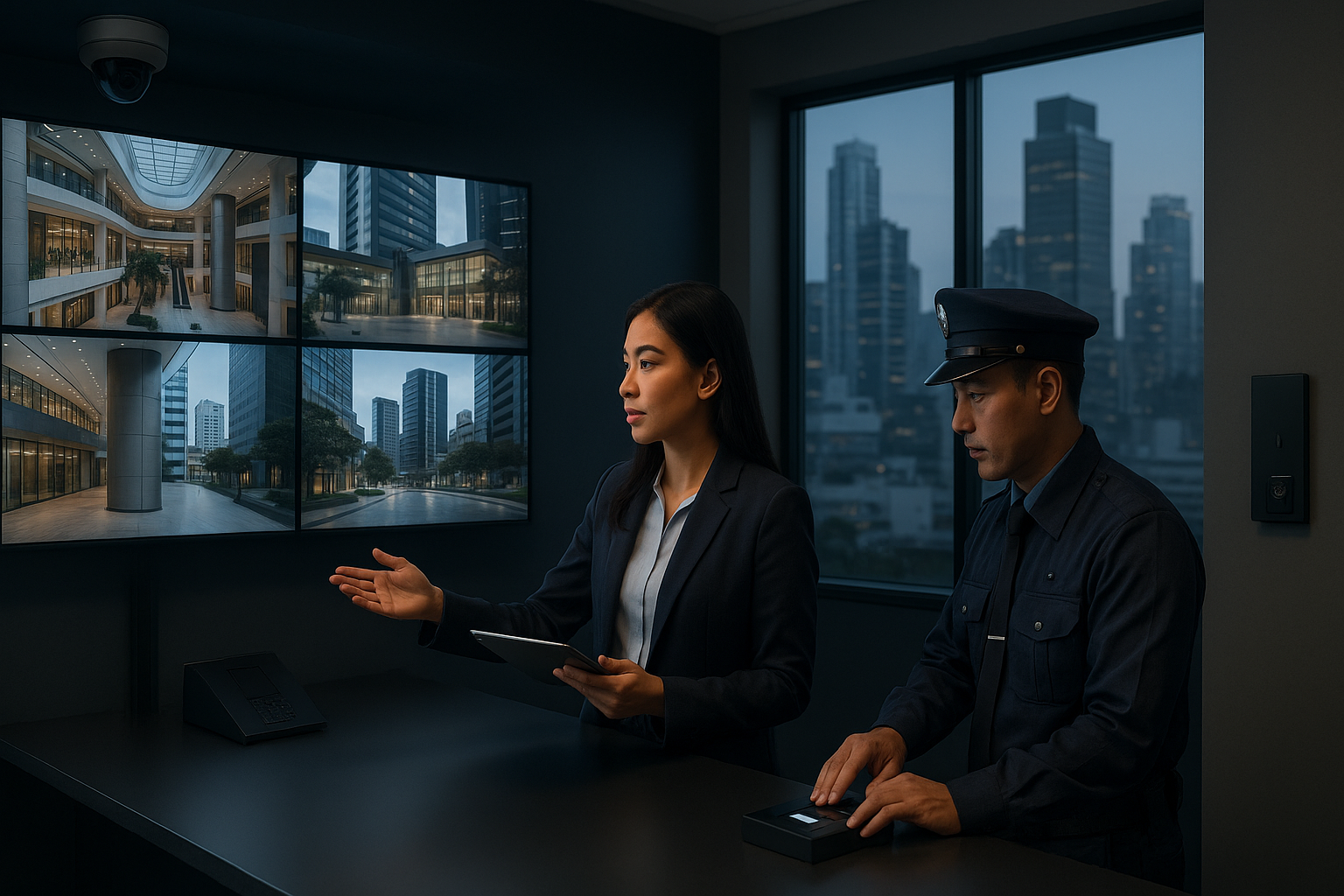
A critical operational question is who watches the video. Local storage without active monitoring limits value to post-incident review. Remote monitoring with event-driven alerts, and integration with an alarm receiving center, turns cameras into an active security sensor.
Access control and identity systems
Access control protects doors, gates, and sensitive areas. Card-based readers remain common for offices and warehouses. Biometric readers add an extra layer where tailgating or shared credentials create risk, though privacy considerations and data storage rules require careful handling. Modern access systems connect to cloud-based management portals so administrators can add or revoke access remotely, schedule credentials, and generate audit trails for compliance.
Visitor management systems improve security for facilities with frequent external guests. These systems log identity, print badges, and can tie visitor access to escorts or time limits.
Intrusion detection and alarms
Intrusion systems use door and window contacts, motion detectors, glass-break sensors, and smart detectors for specific areas. Commercial alarm systems integrate with video so an alarm event triggers camera bookmarks and rapid review. For retail and warehouse environments, perimeter sensors and curtain detectors help protect loading bays and rooftop access points that would be difficult to secure with cameras alone.
Reliable power and tamper-resistant mounting are essential. Many failures traced to intrusion alarms result from poor wiring, inadequate surge protection during storms, or missing battery backups.
Fire and life-safety systems
Fire detection and notification are governed by the Fire Code and enforced by the Bureau of Fire Protection. Commercial fire systems include smoke and heat detectors, manual pull stations, horns, strobes, and interfacing with sprinkler systems and fire panels. Smoke detector placement, maintenance, and recordkeeping are subject to local rules and to insurance requirements. Integrating fire alarm signals with the overall security platform reduces confusion during emergencies and speeds evacuation and first-responder notification.
Perimeter protection and specialized sensors
Large facilities and warehouses benefit from physical barriers plus sensors such as fence vibration detectors, buried cable sensors, or thermal cameras for night detection. Agriculture, remote infrastructure, and construction sites frequently require solar-powered solutions, long-range cameras, and GSM or satellite connectivity for alerts when mains power or fixed networks are unavailable.
Security operations and monitoring
A monitored system matters more than a well-polished front end. Monitoring centers provide alarm verification, escalation, and dispatch, and must be able to communicate with local responders and facility contacts. Managed services add value through scheduled health checks, remote patching, and on-call technicians. Ask whether a provider operates its own monitoring center in the Philippines, uses local partners, or outsources overseas.
Top providers and manufacturers serving the Philippine market
In practice commercial security Philippines solutions come from three groups: hardware manufacturers, local integrators, and service companies that provide monitoring, guarding, or cash logistics. Global manufacturers with strong presence in the Philippines include Axis Communications for cameras, Bosch and Honeywell for integrated systems, Hikvision and Dahua for camera hardware, and Milestone for video management software. These brands supply the core equipment many integrators install.
Security service providers with operations in the Philippines include multinational firms such as Securitas, Chubb, G4S, and ADT, and cash-in-transit specialists such as Brink's for high-risk cash logistics. Local systems integrators supply installation, cabling, civil works, and tailored integrations between CCTV, access control, and alarm systems. Many organizations choose an international brand for hardware and a reputable local integrator for installation and service, ensuring parts availability and fast support.
When reviewing vendors, confirm whether they are authorized resellers for the hardware brand you prefer, whether they provide local warranties, and whether they maintain spare-parts stocks in-country. For managed services, prefer providers with ISO-quality systems or local certifications to demonstrate consistent processes and accountability.
How to choose the right provider and solution
Selection should center on outcomes, not on product features alone. Start with a clear statement of objectives. Do you need loss prevention for retail, access accountability for an office, theft prevention for a warehouse, or protection of a critical facility? Objectives determine sensor type, analytics needs, and monitoring rules.
Evaluate providers on these dimensions: technical competence, local support and presence, SLAs for response and maintenance, experience in your industry, compliance with laws, and transparent pricing. Insist on demonstration systems or pilot deployments when the budget allows. A pilot proves whether analytics thresholds are tuned correctly for local conditions, such as heavy tropical rain or fluctuating power.
Procurement should specify deliverables and KPIs. Typical contractual items include guaranteed uptime, mean time to repair, procedures for firmware updates, and responsibilities for data retention. For cloud services, review data retention locations to ensure compliance with local data privacy expectations.
A short set of practical questions to ask potential vendors includes:
- Do you operate a local monitoring center, or which local partner handles monitoring?
- What is your guaranteed response time for service calls and critical failures?
- How do you secure camera and access control communications from tampering and eavesdropping?
- Can you provide references from similar facilities in the Philippines?
- How will you handle data retention, log access, and compliance with the Data Privacy Act?
- What spare-parts and replacement policies do you maintain for critical components?
Typical solutions by sector
Different industries require tailored designs. A few examples illustrate typical stacks.
Retail chain store: Basic design includes 8 to 16 IP cameras covering the store, POS integration for transaction matching, shelf-level analytics to detect tampering, and remote monitoring for after-hours intrusion. Access control focuses on stockrooms and office areas, while a centralized video management system aggregates footage from all branches for corporate review.
Warehouse and distribution center: Wide-area thermal or high-resolution PTZ cameras cover loading bays and perimeter fences, combined with fence vibration sensors and lighting controls. RFID or barcode-based asset tracking ties into access logs so managers can reconcile inventory movement. Redundant network paths and UPS systems maintain visibility during outages.
Corporate office: Access control integrates with HR systems for automated credentialing and offboarding. Visitor management logs guests and prints ID badges, while ceiling-mounted detectors and evacuation plans integrate into the fire alarm system. Cybersecurity measures protect building automation and security devices from network compromise.
Bank branch and cash handling: Layered physical deterrents include reinforced tellers, ballistic film, high-performance vault locks, and dual-authentication access control. Video systems use high-resolution interior cameras and ANPR to monitor drive-through lanes. Secure transportation uses armored logistics providers for cash movement.
Practical deployment tips and common pitfalls
Environmental realities in the Philippines affect system performance. High humidity corrodes connectors, salt air along coasts speeds weathering, and frequent power surges during storms can damage electronics. Protect outdoor equipment with weather-rated housings, surge protection, and routine maintenance schedules. For coastal sites use marine-grade connectors and stainless fasteners.
Network security is often the weakest link. Cameras and access controllers are networked devices and therefore require the same protections as servers. Segregate security devices on their own VLAN, enforce strong passwords, schedule firmware updates, and require encrypted remote access. For cloud-connected systems enable multi-factor authentication and review vendor security practices.
Avoid the temptation to cut costs on cabling and trenching. Poor cabling causes intermittent failures that are expensive to troubleshoot. Invest in proper PoE switches, UPS for critical devices, and labeled, accessible junction points so technicians can service systems quickly.
Training and governance matter. A system without trained users and clear policies will underperform. Define who can access footage, how long data is retained, how incidents should be escalated, and who receives alarm notifications outside business hours. Log all changes to access permissions for auditability.
Finally, plan for lifecycle costs. Initial purchase price is only part of the expense. Recurring costs include monitoring subscriptions, cloud storage, maintenance contracts, and hardware refresh cycles every five to seven years for cameras and access control hardware.
Maintenance, upgrades, and future-proofing
Security systems evolve. Pick solutions that support standard protocols and open APIs so future integrations are possible without replacing entire systems. When choosing cameras, consider whether your VMS supports AI analytics and whether firmware updates are straightforward. For access control, choose readers and controllers that accept multiple credential types to accommodate shifts from cards to mobile credentials.
Schedule quarterly health checks, and set up automated alerts for offline devices and low storage. Keep a spare parts kit for critical items such as PoE switches, NVR drives, and camera housings to reduce repair time.
Conclusion
Commercial security Philippines requires a layered, practical approach tailored to local conditions and business objectives. Success depends on choosing the right mix of cameras, access control, intrusion detection, and monitoring, then pairing equipment from reliable manufacturers with local integrators who provide fast service and compliance support. Define clear objectives, insist on measurable SLAs, and treat maintenance and cybersecurity as integral parts of the security program. When systems are thoughtfully designed, installed, and maintained, they reduce loss, increase resilience, and free management to focus on running the business.