
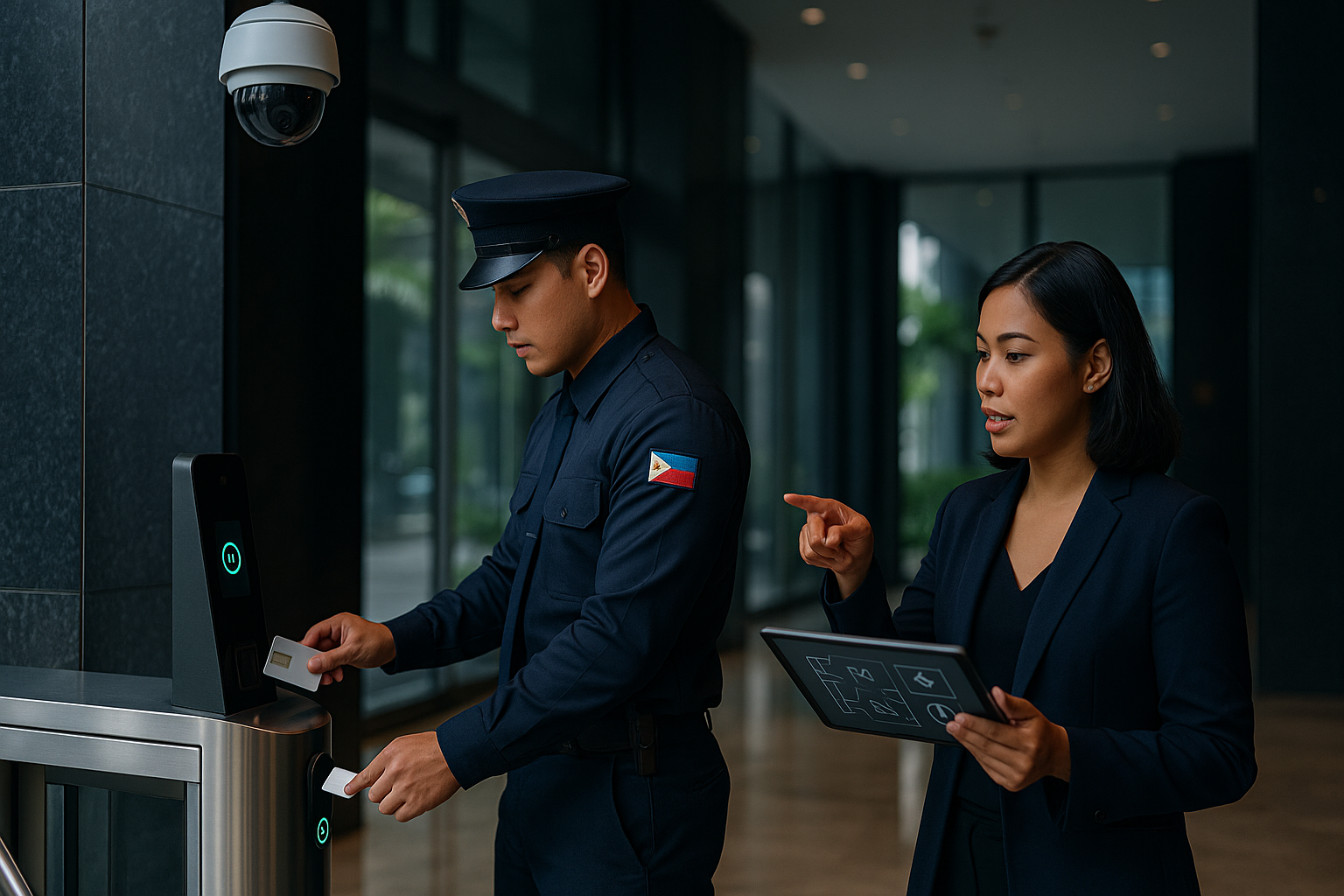
A single failed inspection, a privacy complaint, or an untrained security guard can turn a secure-looking property into a legal and reputational problem overnight. For building owners and managers in the Philippines, compliance is not a one-time checklist. It is an ongoing program that combines law, good practice, technology, and clear documentation.
This guide explains how to build, maintain, and document building security Philippines needs to meet regulatory expectations and protect people and assets. You will get a practical framework that ties the main statutes and agencies to everyday actions: risk assessment, physical and electronic controls, security personnel management, privacy-safe surveillance, emergency planning, and maintaining certificates. Read this as a working manual you can adapt to a commercial building, condominium, factory, or mixed-use property.
What “building security” compliance means in the Philippines
Building security compliance covers three related areas. First, it means meeting construction, occupancy, and fire safety rules that affect how a building is protected, evacuated, and serviced. Second, it covers the lawful use of security measures such as CCTV, access control, and guard deployment. Third, it requires systems to protect workers and tenants, including safety programs, training, and documentation that survive inspections and incidents.
Complying does not mean adopting every security gadget available. It means selecting controls that address identified risks, implementing them correctly, and proving through records that the measures work and are maintained.
Key laws, codes, and agencies you should know
National Building Code (PD 1096) and local building officials The National Building Code sets minimum standards for structure, exits, lighting, and safety systems. Means of egress, stair widths, and emergency signage are examples where compliance affects how people leave a building during a security incident. Local building officials enforce the code and issue the Occupancy Permit you must have before regular operations.
Fire Code (RA 9514) and the Bureau of Fire Protection The Fire Code governs fire prevention, alarm systems, suppression (sprinklers, extinguishers), and emergency response planning. The Bureau of Fire Protection inspects premises and issues a Fire Safety Inspection Certificate, typically renewed yearly. A building that fails a fire inspection faces fines and closure until deficiencies are fixed.
Data Privacy Act (RA 10173) Closed-circuit television cameras, access logs, and electronic badge systems collect personal data. The Data Privacy Act requires lawful purpose, notice, reasonable retention, and safeguards. The National Privacy Commission publishes guidance for CCTV use and data handling. Treat video as sensitive asset data, not just operational footage.
Private security regulation and licensing Private security agencies and guards operate under PNP-SOSIA rules. If you hire guards through an agency, confirm the agency is licensed, guards have required training and certifications, and guard deployment aligns with your risk profile. For in-house security teams, follow equivalent standards, maintain training records, and coordinate with the PNP when needed.
Occupational safety and health (DOLE) DOLE standards and the Implementing Rules for RA 11058 require workplace safety programs, training, incident reporting, and protective measures. Security staff and building operations personnel fall under these regulations.
Local ordinances and LGU permits Municipalities and cities may impose additional requirements, including curfew rules, vendor controls, or barangay clearances. Early engagement with the Local Government Unit clears up expectations and shortens inspection cycles.
A practical compliance roadmap
- Start with a focused security risk assessment Begin by mapping assets, occupants, and plausible threats. A risk assessment should combine physical walk-throughs with consultation of operating records, previous incident reports, and a discussion with tenants or occupants. For example, a ground-floor retail tenant with frequent cash transactions will have different access control and lighting needs than upper-floor offices.
Quantify acceptable risk. Decide what level of theft, unauthorized entry, or vandalism you will tolerate and where you invest to reduce likelihood and consequence.
- Translate risk into prioritized controls Organize controls into three buckets: prevention, detection, and response. Prevention reduces the chance of an incident through locks, barriers, access protocols, and training. Detection lets you know when something is happening through CCTV, alarms, and patrols. Response covers guard action, communication protocols, and coordination with BFP and PNP.
Make the first investments where they reduce the most risk. In many Philippine buildings, this means fixing weak locks and lighting, then adding monitored CCTV and clear access control at entry points.
-
Build policies that match equipment and law Equipment without policy is a liability. Draft clear policies on access control, visitor management, baggage screening, and CCTV usage. Include data retention periods for recorded footage (consistent with the Data Privacy Act), roles that can access footage, and a process for responding to privacy access requests. Make policies available to tenants and staff.
-
Choose technology that is maintainable and privacy-aware Select CCTV cameras that meet image quality needs but also support secure storage and controlled access. Prefer systems that encrypt footage at rest and in transit, support audit logs, and allow selective redaction for privacy. For access control, choose systems that log entries, integrate with visitor management, and can generate reports for auditors.
-
Train, document, and test Train guards and staff on procedures, reporting formats, and legal boundaries. Keep training records, incident logs, patrol reports, and maintenance records in a central binder or digital repository. Perform table-top exercises and full-scale drills for fire evacuation and security incidents. During drills, time egress, test alarms, and evaluate communications.
CCTV and the Data Privacy Act in practice
Install cameras where they serve a legitimate security purpose, such as entrances, parking areas, and service corridors. Do not point cameras at private places where occupants have an expectation of privacy, for example inside restrooms, in private residential balconies, or into neighboring properties.
Post visible notices at entry points that CCTV is in operation, including contact details for data access requests. Keep a privacy impact assessment or rationale that documents the legal basis for camera deployment, the retention period, and technical safeguards. A common retention period for general security footage is 30 to 90 days, adjusted by risk and storage capacity. For footage tied to an incident, move it to secured long-term storage and log access.
When responding to police or court requests, preserve chain of custody. Record the date, requester name, and purpose when you release footage.
Managing security personnel with compliance in focus
Whether you use an agency or hire directly, verify licences, training, and medical fitness. A compliant private security agency will supply guard rosters, training certificates, and supervisory visit logs. For in-house guards, maintain equivalent documentation and ensure supervisors conduct regular performance checks.
Create written standing orders that explain the guard’s lawful powers, limits on using force, search procedures, and when to call the PNP or BFP. Train guards to document incidents immediately using incident report templates. Well-drafted incident reports protect you in liability situations and give regulators what they need during inspections.
Emergency planning and coordination
Emergency plans should be specific, not generic. Define evacuation routes by floor and time, designate assembly points, and name incident commanders for different hours or shifts. Coordinate drills with the Bureau of Fire Protection and the local police precinct when possible. Mutual aid agreements with neighboring buildings or businesses can speed response and reduce damage.
Run realistic drills at least twice a year and after any significant change, like a renovation or change of tenant mix. After each drill, document lessons learned and complete a corrective action log with clear owners and deadlines.
Maintenance, audits, and certificates
Create an annual calendar for recurring tasks: fire safety inspections, building permit renewals, data protection audits, and guard contract reviews. Treat the Fire Safety Inspection Certificate as critical. Failure to get or renew it can lead to closure or fines. For building systems such as fire alarms, sprinklers, lifts, and CCTV servers, follow manufacturer maintenance schedules and document every service event.
Conduct internal audits that mimic a regulator visit. Check for posted signage, working exit lights, unobstructed egress, updated personnel rosters, recent drill reports, and CCTV retention settings. Keep one consolidated compliance folder with physical certificates and scanned backups.
Common pitfalls and how to avoid them
Relying only on technology Over-reliance on cameras or sensors without trained staff to interpret and act on alerts creates blind spots. Technology should support human processes, never replace them.
Ignoring data privacy Recording everything and retaining footage indefinitely increases legal risk. Establish retention policies and stick to them. Train staff on privacy obligations and responses to access requests.
Treating inspections as one-off events Many owners only prepare for inspections after a notice arrives. Continuous compliance reduces stressful last-minute fixes and the chance of fines.
Poor record keeping Regulators ask for documents, not promises. If you cannot produce maintenance logs, training records, or policies during an inspection, you will be treated as non-compliant even if equipment is in place.
Understaffing or low training standards Undertrained guards or thin supervision creates inconsistency in patrols and incident reporting. Invest in regular training, performance reviews, and supervision.
A realistic timeline and sample checklist
If you start from scratch, a typical compliance program roll-out for a medium commercial building takes three to six months. Month one should focus on risk assessment and immediate low-cost fixes like lighting and locks. Months two to four cover installation of CCTV and access control, drafting policies, and training guards. Month five should be reserved for drills and corrective actions, and month six for an internal audit and certificate updates.
A short checklist in prose: confirm your Occupancy Permit and Fire Safety Inspection Certificate are current; complete a documented risk assessment; ensure CCTV coverage is justified and privacy notices are posted; verify guard licensing and training records; have written policies and a tested emergency plan; and maintain an audit-ready folder with all certificates and logs.
Cost considerations and prioritization
Costs vary widely. Basic fixes such as better locks, improved lighting, and signage are relatively inexpensive and usually have the highest immediate return on security. CCTV and access control installation require capital outlay plus ongoing storage and maintenance costs. Guarding involves steady monthly expense, scaled by shift coverage and the skill level required.
Prioritize actions that reduce the biggest exposure first, then spread capital investments over planned budget cycles. Consider condition-based maintenance contracts to avoid surprise failures of critical systems like pumps, alarms, or servers.
Keeping ahead of changes
Regulatory requirements evolve and local interpretations differ. Maintain contact with your city or municipal building official and the local BFP office. Join property managers associations or condominium boards to share experiences about inspections and compliance approaches. When you upgrade systems, ask vendors for documentation that matches regulator expectations, such as compliance certificates for fire-rated doors or alarm system test reports.
Conclusion
Building security Philippines requires is a blend of law, good judgment, and repeatable practice. Focus on a clear risk assessment, implement prioritized controls, manage privacy-sensitive surveillance properly, and keep thorough records. Regular drills, maintenance, and honest audits protect occupants and create a defensible position when regulators or authorities visit. With a structured program, compliance becomes part of daily operations rather than an emergency scramble.